






Wisconsin Students’ Guide to Learning Mechanical Design and Fabrication
Mechanical design and fabrication can lead to strong careers in Wisconsin because the state still has a deep manufacturing base, a large technical college network, active registered apprenticeship programs, and university labs where students can move from sketches to prototypes and production methods.
For a student trying to figure out where to start, the challenge usually is not a lack of options. It is sorting through which option fits your goals, budget, learning style, and timeline.
A student in Wisconsin can start in high school, move into a technical diploma or associate degree, go straight into an apprenticeship, or continue into a bachelor’s program with a stronger engineering focus. Each route can work.
The best choice depends on whether you want to enter the workforce fast, build a design portfolio, qualify for higher-level engineering roles, or combine paid shop experience with classroom learning.
What Mechanical Design and Fabrication Actually Mean
Mechanical design usually centers on turning an idea into a buildable part, product, machine component, or system. Students learn how to read and create technical drawings, work in CAD software, choose materials, size shafts and bearings, think about tolerances, and account for cost, manufacturability, and function.
At Fox Valley Technical College’s Mechanical Design Technology program, for example, students learn to prepare and interpret drawings for products and machine components and solve design problems involving bearings, gears, fasteners, material selection, and product improvement.
Fabrication is the physical side of the process. It covers machining, forming, welding, setup, prototyping, CNC operations, inspection, assembly, and the practical decisions that turn a model on a screen into a real object.
Looking at production-oriented parts like custom hinge bases can help students connect CAD work with the fixture hardware actually used in welding, inspection, and assembly environments.
Wisconsin Technical College System programs in CNC and machine tooling stress hands-on learning, machine operation, blueprint reading, measuring tools, CAD/CAM, and production methods because employers need graduates who can work with actual equipment, not only software.
In real workplaces, design and fabrication overlap all the time. A student may start by editing drawings, then spend part of the week with machinists or technicians checking whether a part is easy to build, inspect, or repair. That back-and-forth is one reason Wisconsin can be a strong place to learn. The state’s training system still supports both sides of the craft.
Also Read: What are some of the best school districs you can find in Wisconsin? Learn more here!
Why Wisconsin Is a Good Place to Learn It
Wisconsin’s technical college system serves more than 293,900 enrollees each year and offers over 500 programs, giving students broad access to applied training close to home. For students who do not want to move immediately or take on a 4-year university bill right away, that statewide network matters a lot.
The state also has a long-established registered apprenticeship system in industrial and manufacturing occupations. Wisconsin’s Department of Workforce Development lists industrial and manufacturing apprenticeship pathways that include machinist and tool and die maker, among others.
A machinist apprenticeship can run 4 years with 8,320 hours of on-the-job training and 432 hours of paid related instruction at Madison College, while Wisconsin’s tool and die maker apprenticeship is listed at about 5 years with 9,888 hours of on-the-job time and 512 hours of paid related instruction.
Wisconsin also keeps adding workforce support tied to advanced manufacturing. In February 2026, state officials announced $7.3 million in new workforce training grant funding aimed at advanced manufacturing and AI-related training, with apprenticeship and pre-apprenticeship among the supported approaches.
That signals a labor market where advanced production skills still matter and are still receiving public backing.
The Main Learning Paths For Wisconsin Students
Students usually end up choosing among 4 main routes. None is automatically best.
| Path | Best For | Typical Outcome |
| High school engineering and CTE | Students testing interest early | Early exposure to CAD, robotics, drafting, shop work |
| Technical diploma or associate degree | Students seeking job-ready skills in 1 to 2 years | Entry-level design, drafting, CNC, tooling, or technician roles |
| Registered apprenticeship | Students who want paid training | Strong shop skills, wages while learning, industry credentials |
| Bachelor’s degree | Students targeting mechanical engineering or advanced design roles | Broader engineering analysis, design, manufacturing, and leadership options |
The table above matches how Wisconsin’s education and workforce systems are organized, from PLTW in schools to WTCS programs, state apprenticeships, and university engineering tracks.
Starting In High School

A smart early start can save time later. Wisconsin’s Department of Public Instruction highlights Project Lead The Way engineering as a college-preparatory, hands-on option that builds career readiness and lab experience.
Programs like that can expose students to drafting, design thinking, teamwork, and prototype work before graduation.
FIRST Wisconsin also runs robotics programs that place students in build-focused team environments where mechanical systems, fabrication choices, troubleshooting, and deadlines all become very real.
For a high school student, robotics or engineering coursework can help answer a basic question: do you actually enjoy long hours spent revising parts, measuring errors, reprinting fixtures, or solving mechanical problems under pressure?
Plenty of students like the idea of engineering until they hit the detail-heavy side of it. Early exposure helps sort that out before tuition bills get larger.
Technical College Route
For many Wisconsin students, the technical college route may be the most practical entry point.
Fox Valley Technical College offers Mechanical Design Technology and Mechanical CAD Drafting, both aimed at students who want to work with drawings, machine components, strength requirements, materials, and product improvement.
WTCS also lists CNC technician, CNC setup/operator, and machine tooling programs built around job-shop and production machining, CAD/CAM, blueprint reading, setup, and metrology.
A student who likes the design side but still wants close contact with manufacturing often fits well here. In 1 or 2 years, you can gain enough skill to enter drafting, CNC support, manufacturing technician, or junior design roles. You also keep the option to transfer or continue toward a higher credential later.
Apprenticeship Route
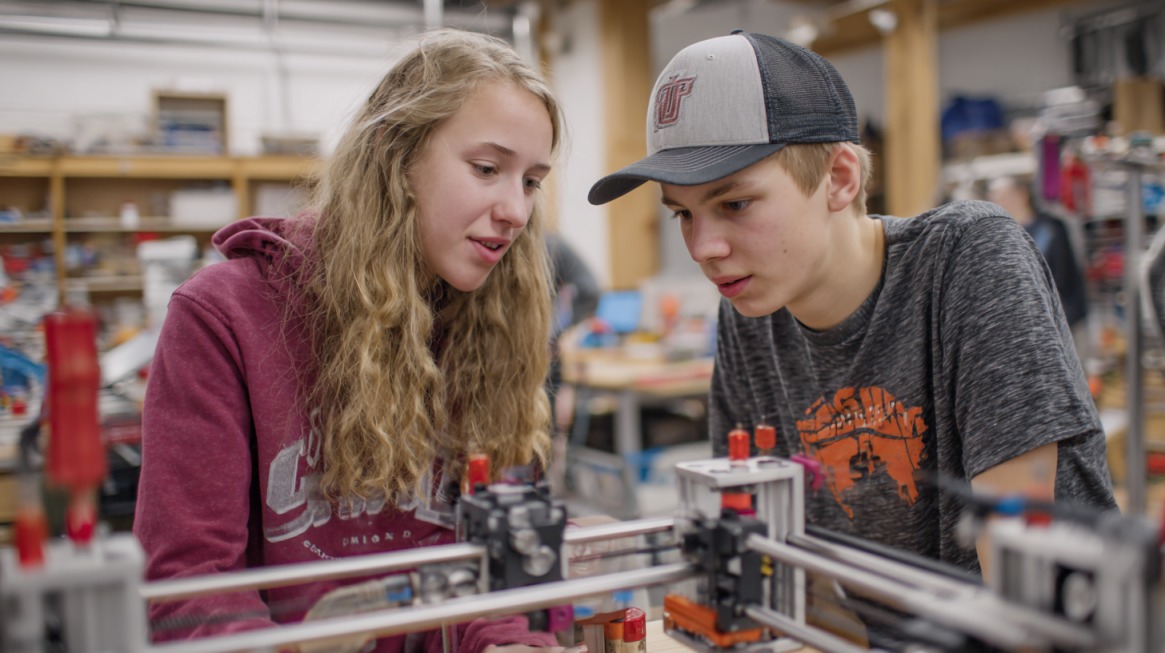
Apprenticeship makes sense for students who want wages early and do well with structured, hands-on learning. Wisconsin’s machinist and tool and die apprenticeships combine paid work with classroom instruction.
The work is demanding and slower to complete than a short certificate, but it offers deep exposure to process control, precision, setup, measurement, machine operation, and production reality.
For someone who learns best by doing, apprenticeship can be a very strong fit. You are not paying to simulate a shop environment. You are in one. The tradeoff is that the pace is tied to employer needs, work schedules, and long training hours.
University Route
Students aiming for mechanical engineering, manufacturing engineering, or product development jobs that involve more analysis may want a university path.
UW-Madison offers a manufacturing engineering certificate inside mechanical engineering, giving students a way to build skills in manufacturing systems and processes.
UW-Madison also offers computer-aided engineering coursework that covers modeling, design of shapes and assemblies, and manufacturing-related topics such as NC machining and 3D printing.
At MSOE, the mechanical engineering program includes specialization options in mechanical design and materials/manufacturing.
UW-Stout’s Additive Manufacturing Lab supports several engineering programs and gives students access to industrial-grade 3D printing and prototyping tools. UW-Madison’s Design Innovation Lab offers over 25,000 square feet of makerspace facilities and fee-for-service fabrication support.
Skills Wisconsin Employers Usually Care About
Students often assume success comes down to software alone. Employers usually want a broader mix.
- CAD and Technical Drawing
- Essential for design, drafting, and product support roles
- Includes building models, revising assemblies, reading prints, and tolerancing
- Clear communication of design changes is critical
- Poor drawings can waste material, labor, and machine time
- Blueprint Reading and Metrology
- Ability to inspect parts is as important as modeling them
- Core skills include precision measurement and blueprint interpretation
- Accuracy is a fundamental requirement in fabrication and machining
- CNC and CAM Literacy
- Understanding how parts are manufactured improves design decisions
- Includes CNC programming, CAD/CAM, and machining processes
- Knowledge of tooling, fixturing, setups, and inspection impacts cost and efficiency
- Materials and Manufacturability
- Good design considers material selection and real-world constraints
- Tolerances, geometry, and production cost must be realistic
- Strong understanding of material strength and manufacturing limits is essential
- Shop Communication
- Work involves constant collaboration across roles
- Requires clear communication with machinists, welders, inspectors, maintenance teams, suppliers, and engineers
- Effective teamwork is key to successful production and design outcomes
Students who can explain why a revision matters, ask useful shop-floor questions, and respond well to criticism usually move faster. UW-Madison’s experiential design work has also highlighted technical communication and project management as part of industry readiness.
A Realistic Plan By Stage
Where you begin matters, but students usually make better decisions when they map the path by age, education level, and how quickly they want hands-on experience.
| Path | Recommended Actions |
|---|---|
| If You Are In High School | Take math, physics, drafting, robotics, or shop courses. Join a robotics team. Explore summer programs like UW-Madison’s Engineering Summer Program. Build projects and keep a portfolio with photos, CAD files, and notes. |
| If You Want To Work Soon After Graduation | Explore WTCS programs such as mechanical design technology, CAD drafting, CNC technician, or machine tooling. Visit labs and understand whether programs focus more on drafting or hands-on machining. |
| If You Want Paid Training | Look into registered apprenticeships through employers and technical colleges. Review Wisconsin’s apprenticeship programs to understand structure and time commitment. |
| If You Want Engineering Roles Later | Consider a bachelor’s degree from schools like UW-Madison, MSOE, or UW-Stout. Focus on programs with strong labs, capstones, makerspaces, and courses in manufacturing, CAD, controls, and materials. |
What Careers Can Grow Out Of It
Mechanical design and fabrication can lead to more than one job title. Students may begin as CAD drafters, CNC setup operators, machinists, maintenance technicians, prototype builders, tooling specialists, or manufacturing technicians, then move into design engineering, process engineering, applications work, supervision, or quality roles over time.
Wisconsin’s training ecosystem supports movement across that spectrum because it includes both short-term applied programs and longer engineering tracks.
National wage data also show why many students keep considering the field. The U.S. Bureau of Labor Statistics reports median annual pay of $63,510 for industrial machinery mechanics, machinery maintenance workers, and millwrights in May 2024, with employment projected to grow 13% from 2024 to 2034.
BLS also reports continuing demand for machinists and tool and die makers, though job outlook varies by specialty and many openings come from replacement needs as workers retire or move on.
No wage number guarantees your outcome, of course. Pay rises with skill level, shift type, region, overtime, employer, and whether you can handle more than one part of the production chain.
A student who can read prints, model parts, communicate with the shop, and solve manufacturing problems usually has more room to grow than someone locked into one narrow task.
@dut.ebe Mechanical Engineering is the most general of all the industry-based occupations, ranging across every stage of the manufacturing process; including design, draughting, assembly, quality control, plant operation, maintenance and management. CAO CODE: DU-D-BGM #mechanicalengineering #engineering #fyp #engineers ♬ original sound – dut.ebe
How To Pay For Training
Money shapes the decision for most students. Wisconsin’s technical college network often gives students a lower-cost entry point than a 4-year residential university, and apprenticeships can let you earn while training.
There are also support programs aimed at trade and industrial learners. Ascendium’s 2025 to 2026 Tools of the Trade Scholarship, for example, offered $2,000 for eligible construction and industrial trade apprentices enrolled in Wisconsin technical colleges, aimed at expenses such as tools and equipment.
Students should also watch workforce grant activity. Wisconsin Fast Forward supports employer-driven training, and new 2026 state-announced federal funding tied to advanced manufacturing and AI may expand opportunities for work-based learning and training partnerships.
Mistakes Students Often Make
A few patterns come up again and again.
- Picking a program based on title alone, without checking lab equipment, course content, and employer links.
- Treating CAD as the whole field, even though fabrication knowledge often changes design quality.
- Ignoring metrology and print reading, then struggling once tolerances matter.
- Waiting too long to build a portfolio of projects, models, fixtures, robot parts, or prototype work.
- Assuming a bachelor’s degree is the only serious path, when technical colleges and apprenticeships remain major entry routes in Wisconsin manufacturing.
Final Thoughts
Wisconsin gives students more than one solid way into mechanical design and fabrication. You can start early in school, move into a technical college lab, earn wages in an apprenticeship, or take a university route with stronger engineering depth.
The best plan is the one that matches how you learn, how fast you want to work, and how far into design, engineering, or production you want to go.
In a state where manufacturing still has real weight, students who combine design skill with practical build knowledge can put themselves in a strong position.