





Top 15 Most Literate Countries in the World (2025 Update)
Literacy tends to carry a reputation for simplicity. People often imagine a clean number, a neat list, and a quick way to determine who sits at the top. Once you step inside the data, the view changes.
Literacy has layers. Some countries measure it through surveys tied to a basic yes or no. Others check whether residents can read a brief message about everyday life. A few build detailed assessments. Plenty still rely on self-reporting. Even the word “rate” can hide a long story about how reading gets used in daily life.
So a 2025 update needs a smarter angle. Two, actually. One deals with basic coverage, meaning whether adults ages fifteen and up can read and write a short, simple statement.
The other deals with functional reading, meaning whether people can use written information in a meaningful way, often measured through standardized testing of fifteen-year-olds. The end result paints a fuller picture of how literacy works in practice.
Top 15 Countries With Reported Adult Literacy Rates

Here are the adult literacy rates according to the CIA World Factbook:
Reported Adult Literacy Rates
Why Literacy Rates Depend on Definitions
Most large international datasets use a definition rooted in the ability to read and write something simple and practical.
For the World Bank’s commonly referenced adult literacy indicator, the standard stays the same: the share of the population aged fifteen and up who can read and write a basic message about everyday life.
The underlying data comes through UNESCO Institute for Statistics, which draws heavily on census rounds and household surveys. When countries do not provide new data, statistical models fill the gaps.
A point that carries weight in 2025: UNESCO stresses that conventional literacy rates still depend heavily on self or household declarations.
Many surveys rely on someone telling an interviewer, “Yes, I can read,” without direct testing. That means the numbers reflect the floor rather than the whole house. They rarely capture deeper skills such as advanced comprehension, digital reading, or numeracy.
Literacy Around the World in 2025

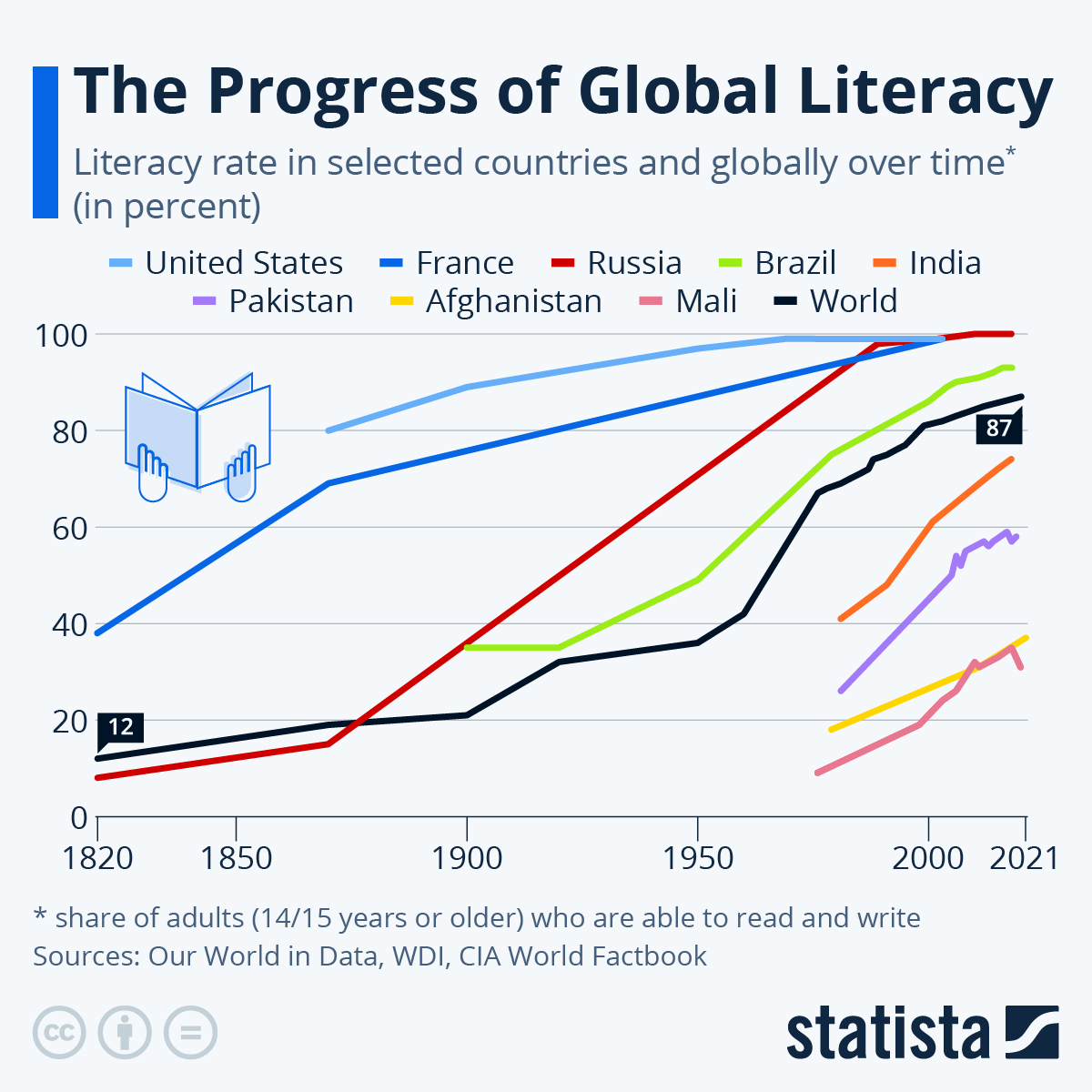
UNESCO’s latest global view offers a steady but uneven trend. Adult literacy climbed from 86% in 2015 to 88% in 2024. Youth literacy reached 93% .
Yet 739 million adults still lacked basic literacy skills in 2024. Most lived in sub-Saharan Africa and Central and Southern Asia.
Women made up almost two-thirds of adults without basic literacy. The global count dropped from 754 million a year earlier, partly because of updated population estimates and a major adjustment to India’s literacy rate, which rose from 77% to 81% .
Another point in the background: a region can lift its literacy rate and still see more adults without literacy when population growth moves faster than gains in education.
UNESCO flags that pattern in sub-Saharan Africa and in Western Asia and Northern Africa over the last decade.
Why Ranking the “Most Literate” Countries Gets Tricky
A global top list only works if the underlying data stays consistent. In reality, countries report literacy in different years and through different instruments. Several high-income countries do not update their figures in the same channels.
Others do not report a single literacy statistic. Some rely on surveys from many years ago. A clean international ranking becomes impossible unless you anchor everything to one source that presents values consistently.
For a transparent 2025 snapshot, the CIA World Factbook’s literacy listing (2023 archive) offers a workable base. It provides adult literacy values, a clear definition note, and the year tied to each figure.
The key is honesty in how the list is framed: the ranking covers countries with reported adult literacy values, not every country on the planet.
How to Read a List Where Everyone Scores Above 99%
When countries reach the upper nineties, small differences no longer tell a full story. A shift from 99.4% to 99.8% can reflect survey design, sampling, definitions, or census timing.
Once basic literacy approaches universality, the real variation moves elsewhere. It lives in classroom practice, in reading stamina, in the ability to interpret complex documents, and in how adults maintain skills throughout life.
UNESCO’s message in 2025 mirrors that idea. Basic literacy counts, but it does not cover digital reading, numeracy, critical evaluation, or advanced comprehension.
Functional Literacy, Tested Through Reading Performance

To get a sense of deeper skills, analysts often turn to PISA reading results. PISA does not test adults. It evaluates reading proficiency among fifteen-year-olds.
That choice still matters because it reveals the strength of the pipeline feeding future adult skills.
Below is the reading performance snapshot you supplied for PISA 2022.
PISA 2022 Reading Scores (Selected Systems)
Why Pisa Matters for a Literacy Discussion
 You will find more infographics at Statista
PISA highlights whether students can extract meaning, evaluate arguments, interpret information, and apply reading skills in unfamiliar contexts. A nation with near-universal basic literacy can still show weak functional literacy if a large portion of students struggle with comprehension.
Reading performance can also reveal gaps between high and low performers, differences in reading engagement, and signs that reading habits are weakening.
In other words, basic literacy tells you whether someone can read a sentence. PISA-style performance tells you how far that skill can take them in a complex world.
What High Literacy Systems Tend to Share
Patterns repeat across the strongest performers. Nothing flashy. Mostly, the daily mechanics of running a stable education system.
1. Near-Universal Primary Education and Completion
Adult literacy grows out of school systems that reach almost everyone. When primary schooling becomes universal, and completion rates stay high, basic literacy follows. UNESCO’s recent reports show wide progress on school enrollment since 2015.
2. Language of Instruction That Students Actually Use
UNESCO notes that roughly 40% of the world’s population receives education in a language they do not fully understand. That affects how students absorb reading instruction and how literacy gets measured.
When instruction mismatches everyday language, literacy outcomes weaken, even if the official scores look stable.
3. Measurement That Reflects Real Skills
Many national literacy surveys still depend on self-reporting. Someone may claim literacy without being tested directly.
UNESCO’s 2025 factsheet warns that direct assessments can show lower proficiency than self-reported data suggests, even in high-income regions. National education systems that maintain transparent monitoring tend to spot weak points earlier and allocate support more effectively.
4. Lifelong Learning That Keeps Skills Alive
Reading skills fade if unused. Countries that support adult education, vocational training, library access, and the wide availability of media tend to sustain literacy across generations.
UNESCO’s framing of literacy as a foundation for digital competence reinforces the idea that literacy never stays static. It evolves with the systems around it.
Common Pitfalls in Literacy Rankings
Writers often run into several predictable mistakes.
Treating 99% as the Final Answer
A figure near 100% looks like success. UNESCO stresses that digital societies demand far more than the ability to read and write briefly.
People need to interpret online content, judge credibility, work with structured documents, fill out forms, and handle digital text formats. Countries with high basic literacy can still face major challenges in digital skills.
Ignoring Missing Data
Several countries do not report literacy rates in the same channels. Some rely on outdated surveys. Others avoid publishing a single national rate.
Missing data does not reflect weaker performance. It often reflects administrative choices or different measurement systems.
Mixing PISA Results With Adult Literacy Rates
Adult literacy rates reflect decades of education. PISA shows what current fifteen-year-olds can do. They measure different generations.
A country can show strong reading scores today while still carrying older adults who never had access to quality schooling. The reverse can happen as well.
A Working Definition for “Most Literate” in 2025

A realistic definition needs to fit the messy reality of measurement. Three criteria tend to capture the core ideas:
1. Near-Universal Basic Literacy
Adult literacy rates at or near 99% where figures are available.
2. Strong Reading Proficiency Among Students
High performance on standardized reading assessments, with broad competence across the distribution, not only among top performers.
3. Skill Maintenance Across Adulthood
Robust adult learning pathways, digital readiness, and ongoing opportunities for skill development.
What the 2025 Data Suggests
When you combine basic literacy coverage and reading proficiency, several countries repeatedly appear in strong standing. Estonia, for example, shows near-universal adult literacy and sits among the top performers in PISA reading.
Singapore leads PISA while maintaining strong national literacy systems through multiple languages. Ireland and Japan report high reading proficiency among students. Several Central and Eastern European systems show high adult literacy figures.
The point becomes clearer once you step away from the idea of a single “winner.” Many systems have reached the stage where basic literacy is nearly universal. The gaps now shift toward practical reading skills, engagement, and digital fluency.
What keeps literacy moving forward
View this post on Instagram
For countries aiming to raise literacy in 2025 and beyond, a few practical approaches remain essential:
-
- Early reading instruction grounded in the language children speak at home.
- Monitoring tools that go beyond self-reported literacy.
- Investment in teacher training and structured reading curricula.
- Support for adult literacy programs that connect directly to employment or daily life tasks.
- Strong public libraries and open-access digital learning platforms.
- National policies that protect education funding over long cycles.
Systems that combine all of that tend to maintain stronger literacy over time.
A Closing Note on What “Top” Really Means
A list of the most literate countries looks simple. The real work happens behind those numbers. Some systems reach 99% literacy through decades of steady school expansion.
Others move quickly through policy shifts, language reforms, or targeted adult education. Some struggle with population growth that outpaces improvement in schooling. Others grapple with the shift toward digital reading.
So a 2025 ranking offers a snapshot. A useful one, but still a snapshot. The most literate countries sit on a foundation built from universal access, consistent quality, sustained investment, and a culture where reading stays alive long after school ends.
The countries at the top of the table share that quiet mix of stability and steady maintenance. The real takeaway is not who sits first, second, or fifth. It is how the strongest systems turn literacy into a living practice that supports everyone, across every stage of life.